.svg)
.svg)


알라미 앱을
다운받아보세요
다운받아보세요
QR코드를 촬영하시면
앱을 다운 받을 스토어로 이동합니다.
앱을 다운 받을 스토어로 이동합니다.

%201.svg)

Ask most app publishers running ad monetization to name the one metric that matters most, and they'll say eCPM. The reasoning: impressions are capped by the product, the placement, and the user, while eCPM seems free of those constraints.
It sounds reasonable. But is eCPM really the core metric you should focus on? And once you've pushed eCPM up, is the monetization job actually done?
Read eCPM without context and it turns out to be far less useful than it looks. It can even distort your view of performance instead of showing how well you're monetizing.
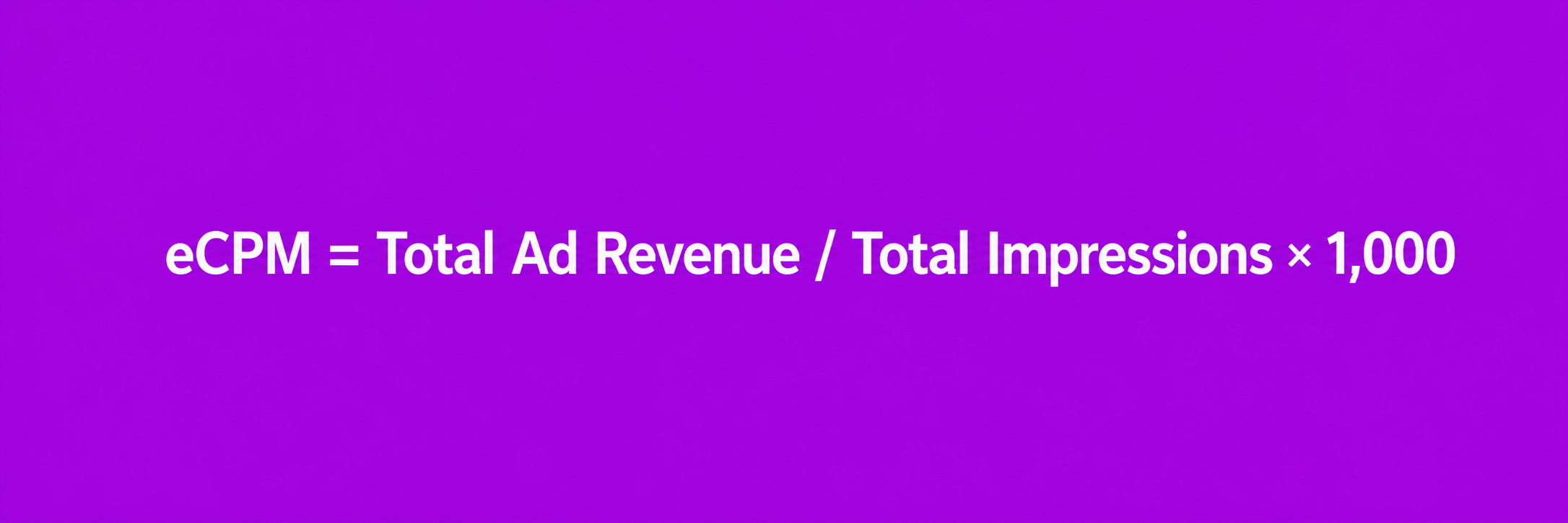
eCPM (effective cost per mille) is revenue per thousand impressions. It tells a monetization lead how much money the app earned for showing users a thousand ads. It's one of the most widely used metrics in ad monetization, and everyone works to raise it. But eCPM is just a price metric, set after the fact by the market.
Like any price, eCPM settles where supply and demand meet. Look at both sides.
Advertisers want the attention of users likely to react to their ads and convert. That need forms demand in the ad market, and the matching traffic gets traded in real time. The higher the demand, the higher the eCPM.
Supply is every impression your users generate across your placements, fed into the market as traffic. The number of ad impressions an app or website can offer sets the supply. So what happens when supply grows? With demand fixed, the price, eCPM, has to fall.
eCPM follows market logic so strictly because it also obeys the law of diminishing marginal utility. Show users the same ad over and over and its effect fades. Advertisers also don't want extra impressions on users who already ignored their ad.
That pushes down the price of repeat impressions. So adding supply naturally drives eCPM down. If you treat eCPM as your performance metric, the move is to cut supply and grow demand. That does raise eCPM, but it makes maximizing revenue impossible. You lose ground on ARPDAU, so it isn't good monetization at all.
Supply and demand are the start, but eCPM has more inputs than that. Without understanding them, publishers ended up treating eCPM as a number to raise blindly. Examine the factors that move eCPM from several angles, and only then can you read eCPM clearly and judge where yours stands today.
Format and placement location play a major role in setting eCPM. Each one drives different user behavior (clicks especially), so reading eCPM without accounting for them is meaningless.
Banner ads generally earn lower eCPMs than full-screen formats. Rewarded video and interstitial ads earn far more because they fill the whole screen and hold the user's attention longer, which sharply raises the odds of a later conversion.
So if you simply want a higher eCPM, use formats and placements that firmly capture attention and prompt action. Ideally a rewarded video ad, which reliably holds attention for 30 seconds or more. But if you paper your app with rewarded video, will users stick around at all?
In practice you'll choose formats and placements that fit your app's UX without hurting retention. Even so, we tend to compare eCPM as raw numbers. Always look behind the number: the underlying conditions can differ, and that alone can explain a different eCPM.
In the programmatic ad market, demand cares most about performance. An app whose users are likely to perform well against an ad naturally attracts more demand.
Demand weighs many user traits, but demographics like country, age, and gender are the most basic. Advertisers prefer countries, ages, and genders with purchasing power, and that preference shows up directly in ad targeting. Hold a lot of users with those traits and your eCPM is naturally higher.
So to raise eCPM, put effort into acquiring users with high purchasing power. That may help far more than a monetization lead grinding to lift eCPM directly.
If high-purchasing-power users attract more demand and lift eCPM, you might expect iOS users, who buy in-app content more often than Android users, to show higher eCPMs. That used to be the trend.
But Apple's ATT (App Tracking Transparency) framework, introduced after iOS 14.5, upended ad campaign efficiency. The IDFA, the identifier used for ad targeting, became hard to use, conversion optimization grew difficult, and advertisers stopped raising ad spend freely.
As a result, Android, where targeting via the GAID is still possible, now carries a higher eCPM than iOS. Rather than concluding that Android is simply higher, recognize that each OS and each user carries different traits, and that, too, can move eCPM.
Many publishers block ad creatives while running monetization. It makes sense: these ads show to your own users, so blocking creatives likely to feel unpleasant is necessary. You also need to guard against, and block, competitors advertising inside your app.
But know that the more creatives you block, the fewer advertisers compete for your impression traffic, and eCPM can drop.
So if your eCPM is very low, check whether you're blocking too much. Blocking creatives users find off-putting is the right call for user experience, but block too aggressively and eCPM can fall.
Finally, mediation. Of every factor above, it's the one ad monetization teams treat as most important. eCPM swings wildly depending on how mediation is set up, so mediation often becomes the yardstick for whether monetization is going well.
Take an app using a single ad network versus an app with a hybrid mediation setup of multiple bidding and waterfall networks. The latter naturally draws far more demand and far stronger price competition, so it can reach a much higher eCPM.
For this reason, publishers treat mediation setup as the most important monetization task and focus on it to raise eCPM. And setup isn't a one-time job. It demands constant A/B testing and optimization to keep up with an ad market that shifts organically.
Because mediation clearly can raise eCPM, every publisher ends up pursuing this direction. But as noted, many factors drive eCPM. Leaning on mediation alone to make eCPM decisions is exactly what an ad monetization team should be most wary of.
So far the argument has been to resist over-focusing on eCPM. But one business model genuinely depends on it: rewards apps. Here the user watches an ad and receives a matching reward, a clear value exchange, so eCPM becomes the core metric for the profitability and sustainability of the business.
Because each ad view maps 1:1 to a reward payout, eCPM sets the ceiling on the reward you can pay per view. So a rewards app has to monitor eCPM closely and design reward amounts on that basis.
For this model to work, you have to offer users a value proposition they find genuinely attractive. The reward has to be one users want, and if eCPM isn't high enough, you can't pay out a reward of that size, which means the service simply can't operate.
So the success of a rewards app comes down to how well you balance eCPM against the reward. Design your unit economics with eCPM firmly in view, and only then can you run the business successfully.
eCPM is a fluid metric: its importance shifts sharply with context and situation. For most apps, chasing eCPM blindly is risky, and trying to raise it without weighing the factors above will hurt overall profitability instead.
But in a model built on a clear value exchange, like a rewards app, eCPM genuinely serves as a core metric. Successful ad monetization comes down to understanding your service and your business model precisely, then finding the right balance between eCPM and the other metrics that matter.











.png)


