.svg)
.svg)


알라미 앱을
다운받아보세요
다운받아보세요
QR코드를 촬영하시면
앱을 다운 받을 스토어로 이동합니다.
앱을 다운 받을 스토어로 이동합니다.

%201.svg)

Watching the ad market, where supply and demand swing fast, often reminds us of the stock market. Read a daily market report explaining yesterday's price moves and you sometimes think, "Ah, so that's why." Other times you wonder whether the reasons were just fitted to the result after the fact. The ad market does differ from the stock market in one way, though: you can look into the causes of its swings more clearly.
Ad revenue is fundamentally impressions multiplied by eCPM. So when developers first start ad monetization, it's easy to expect that as the product's DAU grows, impression volume grows in step and ad revenue rises with it. But the world doesn't bend to our wishes, and ad monetization is no different. Revenue often fails to keep up with rising DAU. Fortunately, you can trace the reasons a little more clearly. That's what we want to get into today.
As noted, the ad market, like the stock market, sees revenue shift under the influence of countless factors. Even so, here are a few things that can sharpen your understanding of the relationship between DAU and revenue.
DAV (Daily Ad Viewers) measures how many users were exposed to an ad on a given day. As the quick-witted reader has already guessed, a rise in DAU very often does not bring a proportional rise in the number of users exposed to ads.
Most app developers treat ad exposure itself as something that harms the product experience, so they often place ads at a deep step rather than in the core flow. In that case, even as new users keep arriving, if the users who stay within the core flow never reach the screen where the ad sits, DAU rises but the actual number of ad-exposed users stalls, and impression volume stalls with it.
As just shown, the number of users seeing ads matters, but which users see them matters just as much. Like the stock market, the ad market has different supply and demand by country, and a country's economic conditions feed in too, so the same placement is priced differently from country to country.
India, for example, has an overwhelming population of 1.4 billion: succeed at market entry and you can secure an enormous user base, but eCPMs there are very low compared with the US. If your service expands globally and grows DAU, but the new country's eCPM is below your existing average, revenue growth proportional to DAU is hard to expect.
This varies not only by country but by mobile OS. And as first-party data grows more important in the ad market, the kind of users you acquire is expected to weigh even more heavily on revenue.

Differences in user activity matter too. Ad revenue comes down to eCPM and impression volume, so beyond simply being exposed to an ad screen, how often a user visits an ad placement matters a great deal. Naturally, a user who opens the product several times a day and explores many screens generates more ad revenue.
So if a one-off or short-term promotion lifts DAU but users don't browse beyond the promotion pages, the ads exposed per user drop, and impression and revenue growth proportional to the DAU rise are hard to expect. That's why it's important to read ad revenue alongside metrics that stand in for product usability, like impressions per user, screens browsed per user, and time on screen, to understand what's actually happening.
It may sound obvious, but eCPM can't be left out either. The ad market, like the stock market, follows the law of supply and demand. As the supplier, a publisher would love to sell its placement at a high price. But just as a flood of new shares pushes a stock price down, a sudden jump in a placement's impression volume can lower the market's appetite for it, so it trades at a lower eCPM. (Want more detail? Is eCPM all you need to look at in ad monetization?)
Ad revenue is shaped by so many internal and external factors that we don't think any single metric captures all of it. (If you know of one, please get in touch.) But to see revenue change against DAU change more clearly, you can look at ARPDAU (Average Revenue Per Daily Active User).
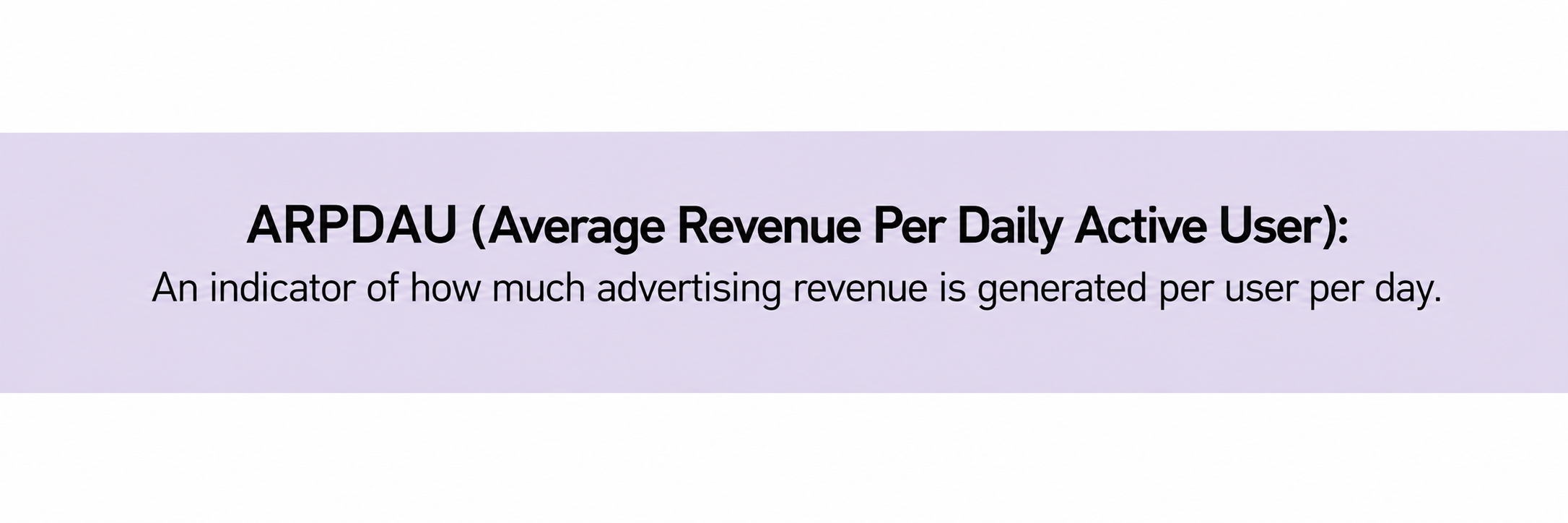
ARPDAU divides total daily revenue by DAU, stripping out the noise of DAU swings to show how revenue per user is actually changing. Break ARPDAU down one level further, into ad impressions per user and eCPM, and you can pinpoint whether a change in daily revenue is really an eCPM issue or an issue with the number of ads exposed per user.
Just as you can't take in the stock market at a glance, the more efficient approach to the ad market is not to try to understand everything perfectly, but to narrow your focus as much as possible, find the actions you can take within that scope, and optimize through continuous experimentation. Rather than getting fixated on one metric, design your metrics proactively and monitor them to build your understanding of what's happening. On that note, we'll wrap up.
















.png)


