.svg)
.svg)


알라미 앱을
다운받아보세요
다운받아보세요
QR코드를 촬영하시면
앱을 다운 받을 스토어로 이동합니다.
앱을 다운 받을 스토어로 이동합니다.

%201.svg)


Every team new to ad monetization hits this moment at least once. You add a single new placement, and the next day you see revenue up on the dashboard. The fact that the number rose when you barely did anything delivers a stronger rush than you'd expect.
The problem is that this experience repeats. Add one placement → revenue rises → add another → it rises again. After this cycle spins a few times, nobody knows exactly how many ad placements the app has anymore. There's a person who added each one, but no one who sees the whole picture.
Adding a placement isn't a bad choice. But once you get used to this dopamine, your hand reflexively reaches to add placements every time revenue stalls. And from that moment, user experience slowly slides into the background.
Keep adding placements and at some point quiet signals start coming in. Ad complaints trickle into the reviews, "too many ads" messages pile up in your support channel. The retention graph starting to bend slightly happens around this time too.
But these signals arrive later than you'd think. VOC doesn't erupt the day you add a placement. Accumulated complaints surface only after weeks or months. By then you've already added two or three more placements.
The trickier part is that users don't describe their complaints precisely. No user writes "the interstitial on the fourth screen is annoying." They just leave "the app got worse" or "it used to be better" and churn quietly. Because the cause is hard to pin down, the response is slow too.
Here's a trap many teams fall into. They conclude that VOC went up so they should cut placements, and they remove the most recently added one. But the complaints don't really go down.
The reason is simple. The point where users feel discomfort isn't the 'number' of placements but their 'position in the journey.'
An ad that appears the moment the app opens and an ad that transitions in naturally after a user has consumed enough content are taken completely differently, even in the same format. Ten placements with low complaints if they're designed to fit the journey flow; five placements with high VOC if they're dropped into breaks with no context.
Before counting placements, look first at the context in which a user meets each ad.
So how should you evaluate a placement? The approach we use is to evaluate each placement on two axes: revenue contribution and UX cost.
First, figure out what share of total ad revenue each placement accounts for. Not just eCPM. Look at that placement's actual impressions and impressions per DAU together. Clearly separating high-contribution placements from low-contribution ones is the starting point.
Measure how much each placement makes users pay in experience. The most useful metric here is the change in retention after exposure to that placement. Look at how D1 and D7 retention differ for the cohort of users who experienced a given placement versus users who didn't, and you can confirm in numbers how much that placement actually burdens users.
Once both axes are evaluated, each placement naturally sorts into four types.
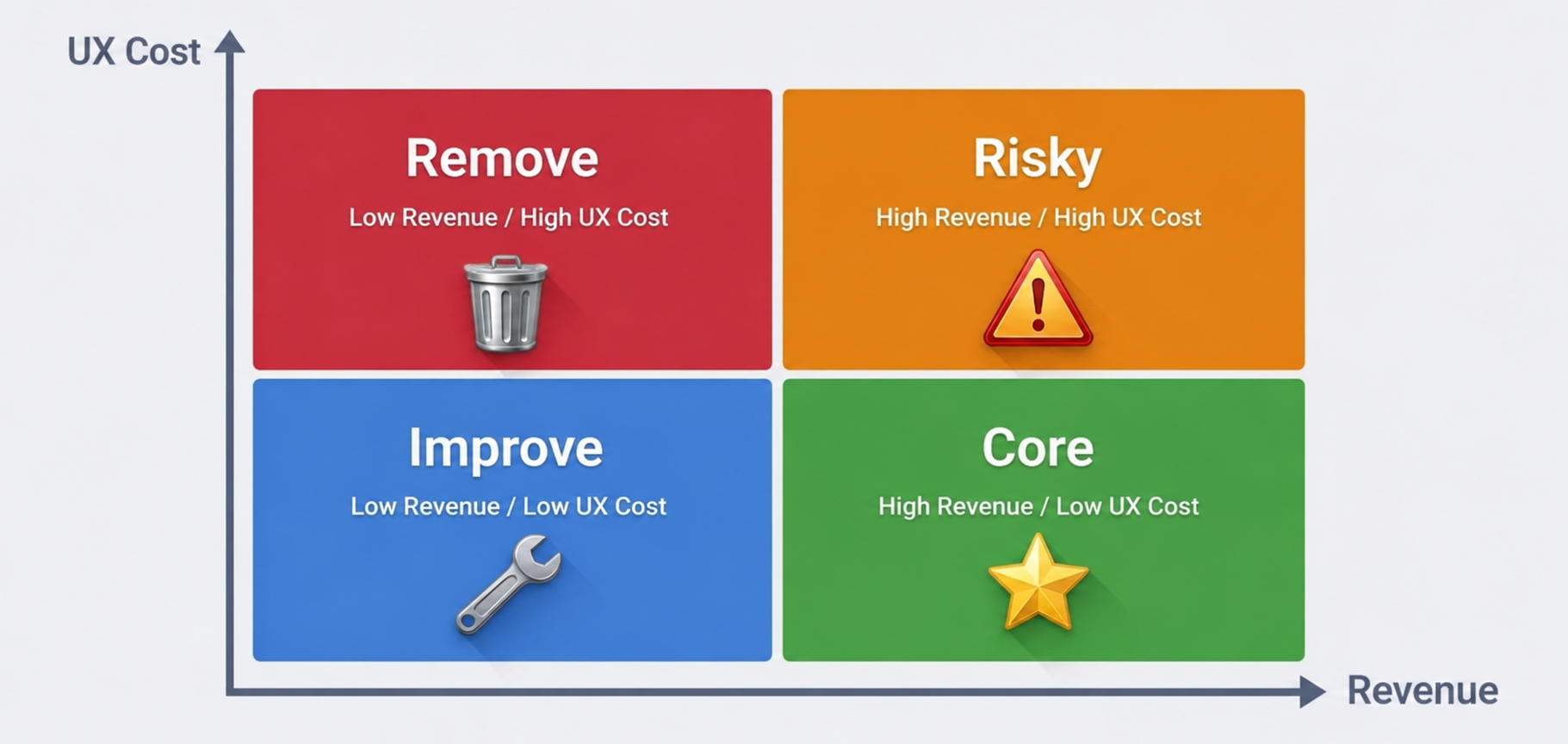
Once the matrix is sorted, put the remaining placements back onto the user journey. Redesign each placement's position and timing around which action the ad follows and which state of user it shows to. Ads are part of the user journey too. The goal is to design ads that blend naturally into the journey, not ads that break its flow.
At first this sounds counterintuitive. Fewer placements means fewer impressions, and fewer impressions should mean less revenue.
In the short term, that's exactly what happens. Remove placements with low revenue contribution and high UX cost, and revenue typically dips slightly for the first few weeks. Many teams can't sit through this stretch and restore the placements.
But look a little longer and the picture changes. When the ad experience improves, retention rises. When retention rises, DAU grows, and when DAU grows, the impression base itself gets larger. A stretch arrives where total ad revenue actually goes up despite the removed placements.
Cutting placements isn't the goal. Making users stay in the app longer and more often is the goal. Ad revenue growing structurally as a result of that is real monetization.
Only a team that watches both short-term revenue and long-term LTV can be said to truly be 'running' its ad placements.
Back to the opening question. Can you say right now how many ad placements your app has? More important than knowing the number is knowing how much each placement contributes to revenue and how much it spends on user experience. When you can answer that question, you can finally say you're running ad monetization properly.














.png)


