.svg)
.svg)


알라미 앱을
다운받아보세요
다운받아보세요
QR코드를 촬영하시면
앱을 다운 받을 스토어로 이동합니다.
앱을 다운 받을 스토어로 이동합니다.

%201.svg)
Alarmy is the alarm app that has woken up 100 million people worldwide. In 2024 it recorded 2 million DAU, ₩30B (~$22M USD) in annual revenue, and ₩19B in operating profit, and has reached number one in 100 countries.
Tell people an alarm app produced those numbers and they usually ask:
"How do you make that kind of ad revenue with an alarm app?"
This post answers that question. It's the story of DARO, the ad platform we built from the experience and the playbook Alarmy has accumulated over many years.
(*DARO: Delightroom Ad Revenue Optimizer)
Ad monetization splits broadly into direct ads and network ads. Direct ads sell straight to the advertiser and carry higher rates; network ads carry lower rates but scale globally easily (e.g., Google AdMob, Meta Audience Network).

From the start, Alarmy's traffic was spread across the world, which made direct ads hard. We had no choice but to rely on network ads — but looking back now, that constraint became an opportunity.
Over the more than 10 years since, we directly tested and operated countless ad-tech products — SSPs, DSPs, and more — from around the world. Along the way we built close partnerships with the big tech companies in advertising, and got early access to technology and APIs not available to the public.
We went further than just using the platforms. We assessed each platform's strengths and weaknesses from an app developer's point of view, built what needed improving ourselves, and modularized the points where revenue could be maximized, one by one.
The operational playbook, partnerships, and technology we accumulated this way combined into an ad engine: DARO.
Here's the question we hear most often (see: DARO can 2x your revenue. So why aren't you using it?).
"There are already big tech platforms like Google AdMob and Meta Audience Network. How can DARO, which just launched, be any better?"
First, to clear up a misunderstanding: DARO is not a competitor to AdMob or AppLovin. It's a partner that helps you use those platforms better.
DARO connects dozens of ad sources — including AdMob and AppLovin — and automatically picks the ad that generates the highest revenue among them. It adds more ad sources and optimization technology on top of the strengths of the platforms you already use.
DARO also didn't come out of nowhere. It's a byproduct of analyzing ad data and applying improvements every day while running Alarmy, now released as a standalone product.

Just as the infrastructure Amazon built for its own e-commerce became AWS and led the cloud market, Alarmy built DARO by solving the ad monetization problems it ran into directly. We find ways to maximize revenue from a publisher's point of view, one at a time, and any improvement we discover goes straight into DARO.
We sometimes put it this way:
"If there were an ad platform that earned more revenue than DARO, Alarmy would switch to it immediately. A 5% efficiency gain alone is worth over ₩1B."
This dogfooding loop — running DARO as a publisher ourselves — is what makes DARO different from other platforms.
(*🔗 Delight Room's acquisition of Between, which many people ask about, was also a deal done as dogfooding for DARO. The point was to test ad monetization on a global service with a different user base and usage pattern than Alarmy's, and feed that experience back into DARO.)
So what exactly is the know-how inside DARO? It comes down to five things.
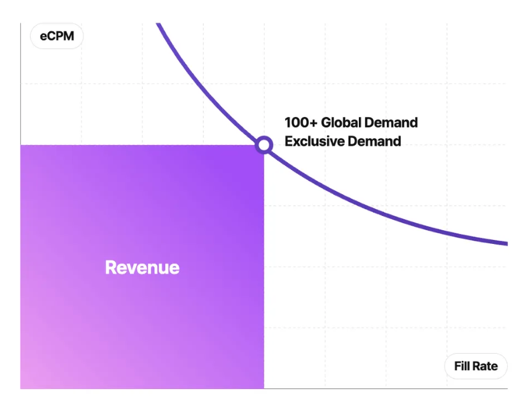
Alarmy continuously tests and uses ad sources from around the world.
Only ad sources whose yield and quality are proven through testing get added to DARO, and Alarmy's scale lets us secure premium advertisers that an ordinary publisher can't reach.
Through the range of ad sources we secure, we also continuously develop DARO's own high-yield ad placements. The bottom text strip banner and the lightweight interstitial — placements unique to DARO that combine the strengths of several ad sources — are good examples.
(See: Interstitial ads, leading a key trend in the ad market)
All of these ad sources are optimized and connected automatically by region and time of day, and DARO handles all the complexity on the back end. (See: This much revenue from that placement?)

Wire many ad SDKs directly into an app and the app gets heavy and hard to manage.
DARO keeps SDK integration to a minimum while connecting a range of ad sources to its own ad server via S2S (server-to-server), taking RTB (real-time bidding) bids in real time, and automatically selecting the highest-priced ad. The app stays light yet reaches more ad demand.
This bidding logic looks simple but holds far more sophisticated technology. Real-time price prediction, performance analysis per ad source, bidding logic that accounts for latency, optimization by user segment — many elements run at once.
If you're curious about the technical detail, see the post below.

An ad passes through several intermediate steps before it reaches you, and each step takes a cut. DARO integrates as directly as possible with DSPs and upstream platforms close to the advertiser, minimizing the distribution steps.
The more intermediate steps in the ad distribution chain, the smaller the publisher's share. DARO removes the unnecessary steps and cuts the distribution margin sharply. Thanks to this leaner distribution chain, the publisher takes home more revenue, and DARO runs on part of the distribution margin it saves.
It's a structure that maximizes the app developer's revenue by cutting the margins various players used to take in the middle of distribution.

Alarmy is serious about maximizing revenue without hurting the user experience (see: Why retention matters in ad monetization).
For a long time, Alarmy has kept testing ad formats and UX that minimize user churn while still earning well — and DARO offers the final winners from that testing.
(See: Balancing UX against ad revenue, Why we chose usability over 2x revenue)
Beyond that, ad quality management is what matters most for the user experience. No matter how good the placement, a low-quality ad in it breaks the experience.
DARO filters out low-quality creatives one more time, right before they're shown — even after they've passed multiple ad platforms' filtering. Look at the report of what gets filtered and the volume of low-quality ads being blocked surprises clients.

An ad platform isn't done once you integrate it. You have to respond quickly to market shifts and policy changes.
Fail to respond properly to policy changes from big tech — Google, Apple, Meta — and you can hit serious problems: revenue clawed back, or the app pulled from the store. DARO spots policy changes early and manages them safely through direct lines to the global ad platforms.
On top of that, the operations team continuously monitors ad metrics every day to detect anomalies, and analyzes in real time how a product update affects ad revenue. That lets us solve problems fast and uncover new improvement opportunities.
(See: Three points easy to miss from a development perspective)
Compliance essential to monetizing global traffic — GDPR, CCPA — is also easy to handle through DARO. And clients above a certain revenue level get direct consulting from Alarmy's own ad monetization team.
For these premium partners, the Alarmy monetization team helps directly — beyond providing a tool — with everything from ad placement design to A/B testing, and UX improvement and revenue optimization through data analysis.
(See: How Alarmy gets 200% out of its ad data, How to analyze why revenue dropped)
Clients that adopted DARO saw ad revenue rise 1.5–3x on average. Among clients receiving ongoing consulting, some grew more than 5x. There are startups that crossed BEP on the ad revenue lift after adopting DARO.
But what's more meaningful than the numbers is the change clients actually experience.
"Development around ad policy got much simpler. Global compliance work like GDPR was a real headache, and now that DARO handles it for us, we can focus only on building the product."
— CTO, global utility app
"Settling separately with several ad platforms used to take three months each, and we had to track receivables on top of that. Now DARO settles it all in one batch within a month. Cash flow improved, and running the business got a lot easier."
— CEO, global rewards app
"Whenever we added SDKs to lift ad revenue, the app would get unstable and odd ads would show up. DARO connects more ad sources and yet the app is actually more stable, and it filters out low-quality ads on its own."
— Business lead, commerce app
"They don't just hand over an SDK — they analyzed our app's user flow and proposed ad placements that don't hurt the UX. They worked with us from A/B test design through results analysis, so we could keep refining our app's ad revenue."
— PM, DARO premium partner
Hearing this kind of VoC — that we solved an ad monetization problem clients had struggled with, freeing them to focus on more important product work — is the most rewarding moment of all.
Read this far and it can look like there's no reason not to use DARO. Honestly, though, there are cases where DARO isn't the right fit.
Some clients abandon the integration partway, or leave after using it. The reasons fall into three broad patterns.
DARO isn't right for every company. So we focus on working properly with the companies that need DARO and understand how DARO works.
DARO isn't a project we started with a grand vision. It came together naturally as we solved Alarmy's own ad monetization problems, and we released it because we thought it could solve other app developers' problems too.
Right now, Delight Room is applying new ad technology, testing a range of ad sources, and searching for better ways to monetize. Every improvement we find goes into DARO. Adopting DARO means you get not only our 10 years of experience, but today's discoveries and tomorrow's improvements with it.
The problem DARO sets out to solve is simple: we take on the complexity of ad monetization so app developers can focus only on the product.
If you'd like, you can run DARO against your current platform and see the difference in ad performance for yourself. That's how we started too.






.png)


