.svg)
.svg)


알라미 앱을
다운받아보세요
다운받아보세요
QR코드를 촬영하시면
앱을 다운 받을 스토어로 이동합니다.
앱을 다운 받을 스토어로 이동합니다.

%201.svg)
Honestly, we built DARO out of need more than out of any grand vision.
Run Alarmy long enough and you always hit a point where things stall. The initial setup is done, the major networks are connected, and revenue is coming in at some level. But it won't climb past that. Touch something to lift it, and something else breaks. Add more ads, and users react; protect users, and revenue stays flat. You solve pain points one by one, and at some point you're standing in front of a limit point.
We've been living that feeling with Alarmy for 14 years. So DARO didn't start from "it would be nice if a service like this existed." It started from "this service didn't exist, and that made things so hard for us." We've been through it, so we understand it; we understand it, so we can take an approach that actually helps.
When teams choose a monetization partner, many of them ask, "Is this company any good?" But the more important question is a different one. "Does this company think from the same position I'm in?" We believe DARO is a team that can answer that question differently.
Run monetization long enough and you notice something odd. There are things neither ad networks nor mediation platforms tell you upfront.
Here's an example. A new SDK version ships, and they recommend you update. But not every version is safe to adopt right away. Some versions actually eat into ad show rate in certain environments: rendering timing slips, initialization order gets tangled, caching behaves strangely. Your metrics wobble subtly and you don't know why. Finding that reason takes running the app yourself and tracking it over a long time.
Some features we use aggressively, some versions we hold off on, and some inefficiencies we fix directly at the SDK level. These are judgments built up from running Alarmy, and DARO's SDK has those judgments built into it. A partner won't tell you this upfront. You only know it once you've been through it yourself.
Mediation setup is the same. Which networks to put in competition and in what order, where to set the floor price, when to switch to bidding. Setups that look similar on paper produce completely different results depending on the app's actual traffic structure, user patterns, and content. You can't catch that difference by instinct without hundreds of experiments. DARO has been running those experiments on Alarmy for years.
"Deleted the app because of the ads."
Reviews like this show up on Alarmy too sometimes. This isn't a story about someone else's app. Which creative makes users uncomfortable, which timing leads to churn. We experience it directly. And that experience feeds straight into how DARO operates.
We refine creative filtering, build UX-friendly ad placements ourselves (the DARO light popup article), and share a weekly report on which ads we blocked. This is possible because we run our own app. Whatever problem other publishers face, we face it too.
Retention and monetization often feel like they're inversely related. The formula: add ads and users leave, protect users and revenue shrinks. But that's the feeling you get in an under-optimized state. Depending on which format you show, at what frequency, and at what timing, the same number of impressions can produce a completely different user reaction. That's exactly why DARO researches and builds new ad formats itself.
Monetization isn't set-it-once-and-done. Network policies change, platform updates land, user patterns shift. Stand still and at some point a setup that was optimized stops being optimal.
So we test every week. Interstitial frequency, banner placement, floor price tiers, bidding switch timing. We run it on Alarmy first and apply only what holds up to customer apps. Starting from a blank slate is different from starting with hundreds of experiment logs in hand. The speed of initial optimization alone is different. And those experiments still continue every week.
One thing matters here. The point isn't to run "a lot" of experiments but to run them "right." Change several things at once without controlling your variables, and you can't tell which factor produced the result. DARO works with a system, from experiment design through interpretation. The instinct for telling which result is noise and which is signal also comes from years of experimentation.
.png)
A mediation platform advises in the direction of more usage of its own platform. An ad network recommends setups that favor its own advertisers. This isn't wrong. It's natural from where they stand.
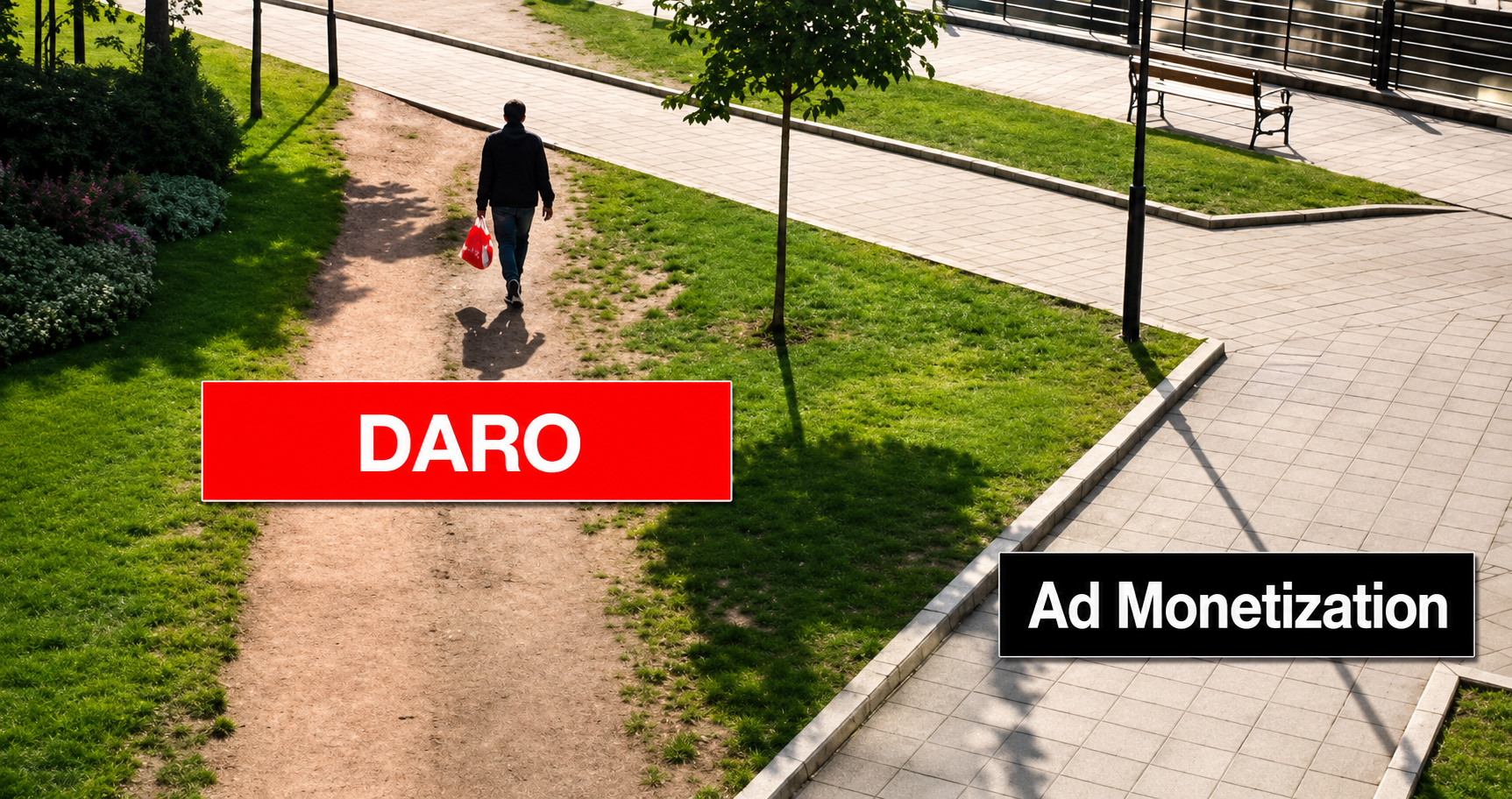
DARO is a publisher. We're a team that has spent 14 years running Alarmy and doing the math on capturing revenue without losing users. We look at other publishers' apps from that position.
One of the most dangerous situations in getting consulting is when the person giving advice doesn't bear the cost of failure. They recommend a bad setup and take no hit. The publisher is the one whose rating drops, whose users churn, whose revenue wobbles. DARO bears that cost directly through Alarmy, a live app. Advice that's bad for us is bad for us too.
We know that feeling: solving pain points and then standing in front of a limit point. We don't stop at empathy; we keep pushing forward with people and technology, and that's why Alarmy and DARO's customers both produce meaningful results. Because these are problems we ran into first.

"Is our app's monetization actually going well right now?"
If that question has crossed your mind even once, the feeling is right. When you don't know monetization well, it keeps running without you knowing. It starts with figuring out whether your current setup is optimal or not. Running experiments constantly to capture, in numbers, what's working and what you're missing. Moving with DARO is one of those answers.
If you've ever solved pain points and ended up in front of a limit point, now it's time to break it.






.png)


