.svg)
.svg)


알라미 앱을
다운받아보세요
다운받아보세요
QR코드를 촬영하시면
앱을 다운 받을 스토어로 이동합니다.
앱을 다운 받을 스토어로 이동합니다.

%201.svg)

What words come to mind when you hear "ad monetization"?
The terms that come up most in monetization discussions are performance metrics: eCPM, requests, impressions. Numbers are intuitive, so most publishers spend their time on how to lift eCPM and how to grow impressions.
But don't forget that a metric is an output. If you want to start ad monetization, or you've already started and want to fix a problem, you have to understand the background and the logic that produced the metric before you can even define the problem.
Ad monetization works because advertisers want to buy ad placements (demand) and publishers want to sell them (supply), and those needs meet at some point. The demand side matters more here. Without advertisers wanting to advertise, a publisher's inventory won't sell. So it's the demand side that has driven the ad monetization market forward.
This post looks at ad monetization through exactly that lens: supply and demand.
The answer is simple. They want clear results in return for the money they spend. Clear results mean getting their product or service in front of many people and, finally, driving a sale.
On mobile, an advertiser uses ads to put their product in front of potential customers, build awareness, and earn further responses like clicks and purchases. If the results outweigh the cost of running the ad, the ad is efficient. Naturally, advertisers want to pay more for efficient ad slots with proven results.
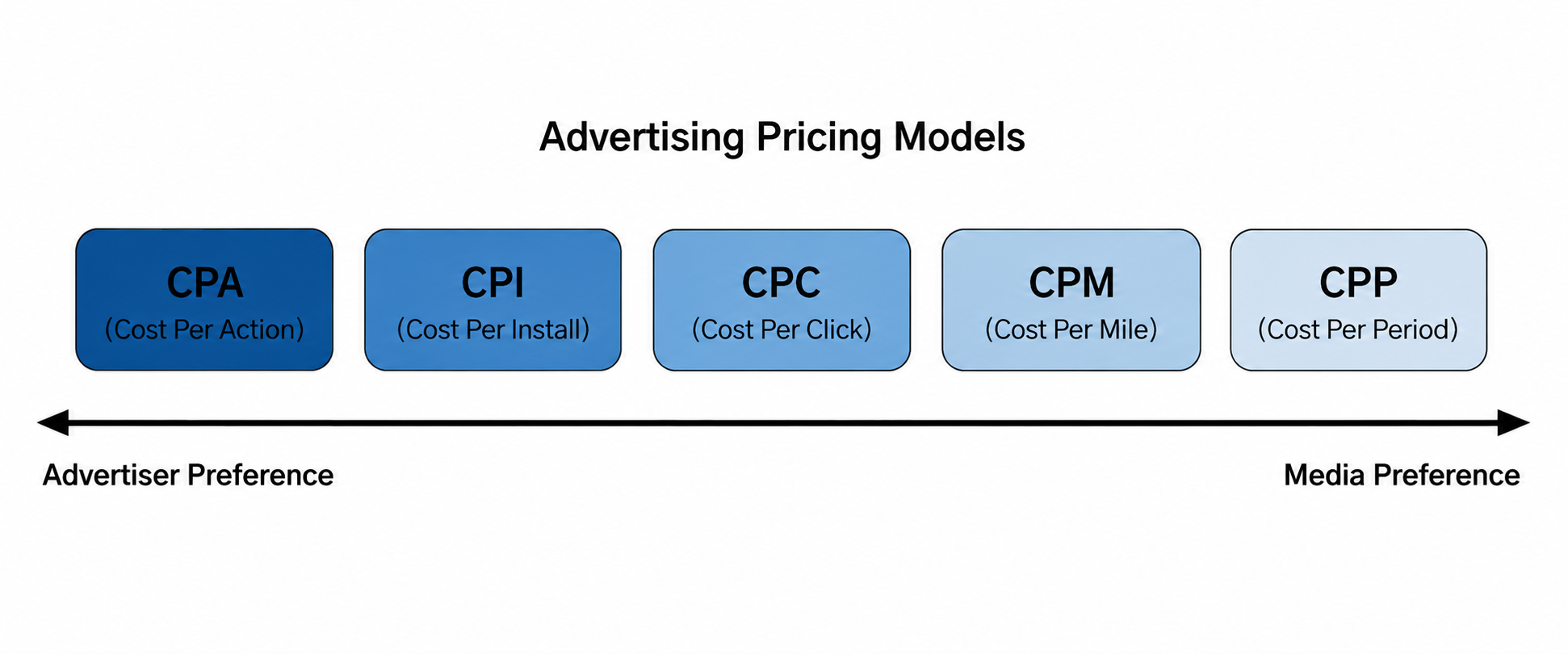
Ad tech advanced to serve that advertiser need to judge "the more efficient ad." Pricing models like CPM, CPC, and CPI emerged, and the technology to track purchases, installs, clicks, and impressions grew alongside them. CPM became the most common method, and from the publisher's side the concept of average price per thousand impressions, eCPM, naturally followed and grew important.
So in a market where CPM is the norm, what does a spending advertiser want? A response from potential customers through ad impressions.
For that, the ad first has to stand out. That runs against what a publisher wants. Thinking about usability, a publisher would rather the ad blend into the app's content and stay unobtrusive. But as we saw, the ad market runs on the logic of demand like most other markets, so an ad users don't notice is likely judged inefficient. An inefficient ad has low advertiser demand, so its price drops too. That's why an ad that "looks good for UX because it's unobtrusive" rarely produces meaningful ad revenue.
The pricing and evolution of mobile ad formats is also tied closely to efficiency. Among the major mobile formats, average price generally rises in this order: native, banner, interstitial, rewarded video (RV).
Native, as the name suggests, hands the publisher the components to customize for a natural look. Built to be unobtrusive, it can price below a standard banner. But design a native ad at a size and form that draws attention, and the price can rise.
For banners, the 320x50 strip is most common, though the 300x250 MREC banner is also frequent. The larger MREC stands out more, so its price runs higher. Even within one format, the more it stands out, the better its efficiency and the more likely its price climbs.
What about the rest? Interstitial and RV both cover the entire mobile screen, so they capture attention by design, and responses like clicks and installs come more easily. Their prices sit far above native and banner, which is easy to predict by now.
Interstitials are usually skippable within five seconds, but RV can't be skipped, and the video usually runs a full 30 seconds, so advertisers favor it too. That's why RV tends to carry the highest price.
As the economy has weakened recently, ad budgets have trended down, and existing formats have evolved to deliver more performance on the same budget. Banners, for instance, once showed only images; lately they've moved to a multi-format style that also serves video ads to drive user engagement. Interstitial and RV now often run playable creatives that let users try a game directly, and end cards have become standard, guiding users smoothly toward a click and install.
To sum up: the first thing a publisher should think about in ad monetization is not the individual metrics but how attractive my ad slots are to advertisers.
To raise that appeal, you need a clear read on which ads your users respond well to and what they're likely to do when an ad appears. Only then can you steer them toward the result advertisers want. In other words, understand your app's characteristics and the tendencies of its users, and you can set a monetization strategy that fits. A later post will cover which ad monetization strategy to take in more detail.







.png)


